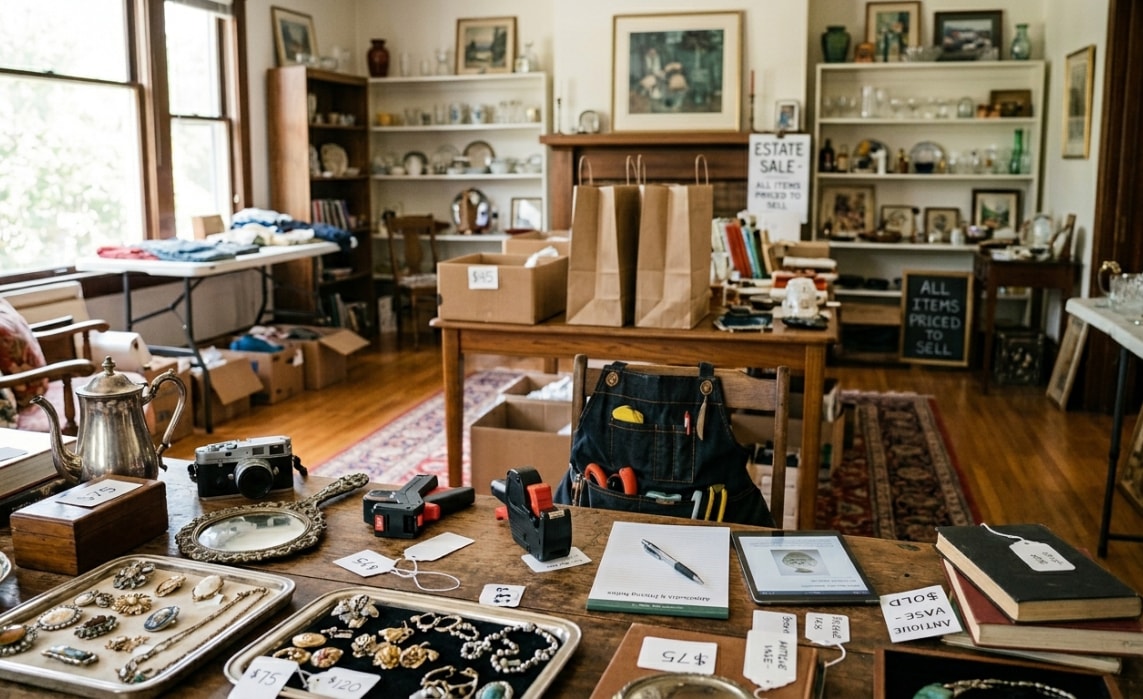
How do you price items for an estate sale? The answer comes down to recognizing that your goal is liquidation, not retail profit. Estate sale prices reflect what buyers are willing to pay today rather than store prices.
Pricing items according to fair market value is challenging on your own. Fortunately, Mile High Estate Sales can help you sell 80% to 95% of your items by the end of your sale.
What Estate Sale Pricing Really Means
Unlike retail stores and antique shops, our estate sale pricing guide prioritizes speed and volume over the maximum price per item. Estate sale pricing requires setting competitive prices so that items sell within two to four days.
If you price items too high, you'll be stuck with lots of unsold inventory. Yet, if you price everything too low, you're unnecessarily leaving money on the table. The sweet spot lies between your profit and the sell-through rate.
For example, if an item's retail value is $100, set the estate sale price to $30 to $70, depending on buyer demand and the item's condition.
Why Pricing Strategy Determines Estate Sale Success
How you price items for an estate sale directly impacts your total revenue, sell-through rate, and buyer satisfaction. A poorly priced sale could leave you with frustrated buyers and over half of your items unsold.
Most estate sale revenue is generated on the first day, which is why items are sold at full price before discounts are applied. Estate sale pricing also affects reputation: companies known for being overpriced yield low turnouts, while those with fair pricing attract word-of-mouth and repeat buyers.
Core Principle: Price at Fair Market Value (Not Retail)
Fair market value is at the heart of any successful estate sale. An item's fair market value is what a buyer is willing to pay in the current market, rather than what a seller hopes to get or what it originally cost.
As a general rule, estate sale prices are 30% to 70% of the online resale value. You can refer to eBay “sold” (not active) listings to arrive at an appropriate estate sale price. However, adjust your pricing based on local demand, sale location, and buyer demographics.
Key Factors That Determine Estate Sale Prices
- Condition — Like-new items sell for more than worn, damaged goods
- Rarity — Unique items may warrant higher prices
- Demand — Trending categories for collectibles and era-specific furniture may move faster
- Brand — Who made your piece could impact its perceived value
- Completeness — Full sets of collectibles, china, and tools have more value than partial sets
- Local trends — Regional market trends drive desirable items at sales
- Timing — Consider seasonal demand for holiday décor and spring garden tools
- Presentation — Stage your items attractively to boost value perceptions
- Urgency — Aggressive pricing may be needed for quick liquidation
Step-by-Step Estate Sale Pricing Process
- 1Sort and categorize all items, separating high-value pieces from everyday goods
- 2Set aside items that require pricing research, such as antiques, jewelry, and artwork
- 3Use eBay "sold" listings and auction sites to research comparable prices
- 4Assign prices based on condition and demand
- 5Price high-value items individually, keeping them visible and protected
- 6Use bulk pricing for low-value items, such as common books
- 7Stage items before settling on final prices, as presentation can influence perceived value
- 8Do a final walkthrough to make sure all items are clearly priced
- 9Prepare for subsequent-day price reductions for unsold items
How to Research Estate Sale Prices
The most reliable baseline for estate sale pricing is eBay “sold” listings, but you can also use Google Lens to identify items you're not sure about. Additional research resources include:
- Auction sites like LiveAuctioneers and WorthPoint
- Replacements.com for china and tableware
- AskArt for fine art
An important consideration for what sells at estate sales is always to verify the materials used and the authenticity of items. If you think something could be worth more than $500, consider consulting a professional appraiser.
Pricing by Category vs. Individual Pricing
It's typically best to price valuable items individually, such as:
- Jewelry
- Art
- Collectibles
- Furniture
However, you can use category pricing for lower-value items, including:
- Books ($1 to $5)
- Clothes ($5 to $20)
Category pricing for items of equal value saves you time while simplifying the shopping experience for buyers.
Discounting Strategy for Multi-Day Estate Sales
A structured, logical discount plan will help you maximize sales after the first sale day:
These strategies create a sense of urgency among buyers, encourage repeat visits, and clear out your remaining inventory.
Common Estate Sale Pricing Mistakes to Avoid
Now that you know how to price items for an estate sale, you can avoid these common pitfalls:
- Pricing items based on emotional attachment
- Not researching valuable items
- Using wishful or retail-based pricing
- Underpricing collectible items
- Poorly staging your items
- Assuming all similar items have the same value
- Not implementing a multi-day discount strategy
Advanced Pricing Strategies (Maximizing Revenue)
You can take your estate sale pricing to the next level with these tactics:
- Anchor prices — Start slightly higher to allow room for negotiation
- Bundle deals — Offer groupings like three similar items for $10
- Strategic placement — Position high-value items near checkout to maximize visibility
- Psychological pricing — Use $45 instead of $50 — it feels like a better deal
- Scarcity tactics — Highlight rare items to create urgency among buyers
- Dynamic pricing — Adjust prices based on demand and foot traffic throughout the sale
Special Scenarios: Picker Sales & Bulk Liquidation
In some situations, traditional pricing isn't practical. Picker/discovery sales work well when you have a large inventory of low-value items and allow buyers to negotiate at checkout. Bulk pricing strategies may also help in this situation, such as fill-a-bag deals for $20.
Many estate sellers use a hybrid approach, individually pricing valuable items while leaving the rest for bulk and picker-style sales.
How Pricing Impacts Your Reputation and Results
As an established and trusted local estate sale company with service areas throughout Colorado, we know how pricing shapes long-term success.
The estate sale community openly shares experiences, and fair, consistent pricing builds trust, repeat buyers, and strong referrals. Companies like ours, known for consistently fair estate sale prices, see higher attendance and better revenue outcomes.
FAQs About Estate Sale Pricing
How do I know what price to put on estate sale items?
Research comparable sold items and adjust pricing based on condition and local demand.
Should I price everything individually or in groups?
Consider individual pricing for high-value items and category pricing for everyday goods.
How much should I discount items each day?
Many people sell items at full price on day one, 25% off on day two, and 50% off on day three.
What if I can't find a price for an item?
Find similar items to use as a benchmark, or consult an appraiser for high-value pieces.
Is it better to price high and negotiate or price low?
Balanced pricing typically works best — low enough to encourage sales, but high enough to bring a profit.
When should I hire a professional appraiser?
If you believe an item is worth more than $500, consider an appraiser, especially for art, antiques, and rare collectibles.
If you have additional questions, please visit our FAQ page or contact us for a free estate sale consultation.

Mile High Estate Sales
Colorado's trusted estate sale professionals with over 10 years of experience helping families through life's transitions.
Schedule a Free Consultation